
Desi pubs

Racial segregation, it is often thought in Britain, is (or was) a peculiarly American phenomenon. Despite our colonial past, the social exclusion imposed on non-white immigrants to the UK during the post-war period is seldom acknowledged in the popular narrative of 20th Century Britain. The effect of this is to downplay the lived experience of the UK’s immigrant communities so that the very word “segregation” recalls images – of “colored” water fountains or bus station waiting rooms, perhaps – from Birmingham, Alabama rather than Birmingham in the English West Midlands.
But the UK has an ignominious history of segregation all of its own and one that bears some striking similarities to that of the Jim Crow South. Indeed, on a solidarity visit to Smethwick in 1964, Malcolm X declared the racism he witnessed there to be even worse than its American variant. It infected all areas of social life, including workplaces, shops and public transport but in few places is its history more visible than in that most cherished of British institutions, the pub.
In Britain, unlike in the southern United States, there were never any laws explicitly requiring racial segregation. But before the passing of the Race Relations Act in 1965 there was no law to prohibit it either. In this context, an informal system of segregation took hold: many publicans introduced a “colour bar”, refusing service to non-white customers.1 Whether through overt racism on their own part or else from fear of their white patrons taking flight at the prospect of sharing their social spaces with black and brown people, the effect was much the same: if you weren’t white, the pub was not a welcoming place.
Enter the desi pub. The Durham Ox in Leicester, which was taken on by a Mr Soham Singh in 1962, is credited as the first pub in the country to be managed by someone of south Asian heritage. It was around this time that breweries began to cotton on to the commercial potential of the non-white customer base and in neighbourhoods with significant immigrant populations some began to recruit Indian landlords to struggling pubs in an effort to attract a new clientele. The approach proved successful, and the number of such places continued to grow in towns and cities across the country throughout the 1970s and 1980s.
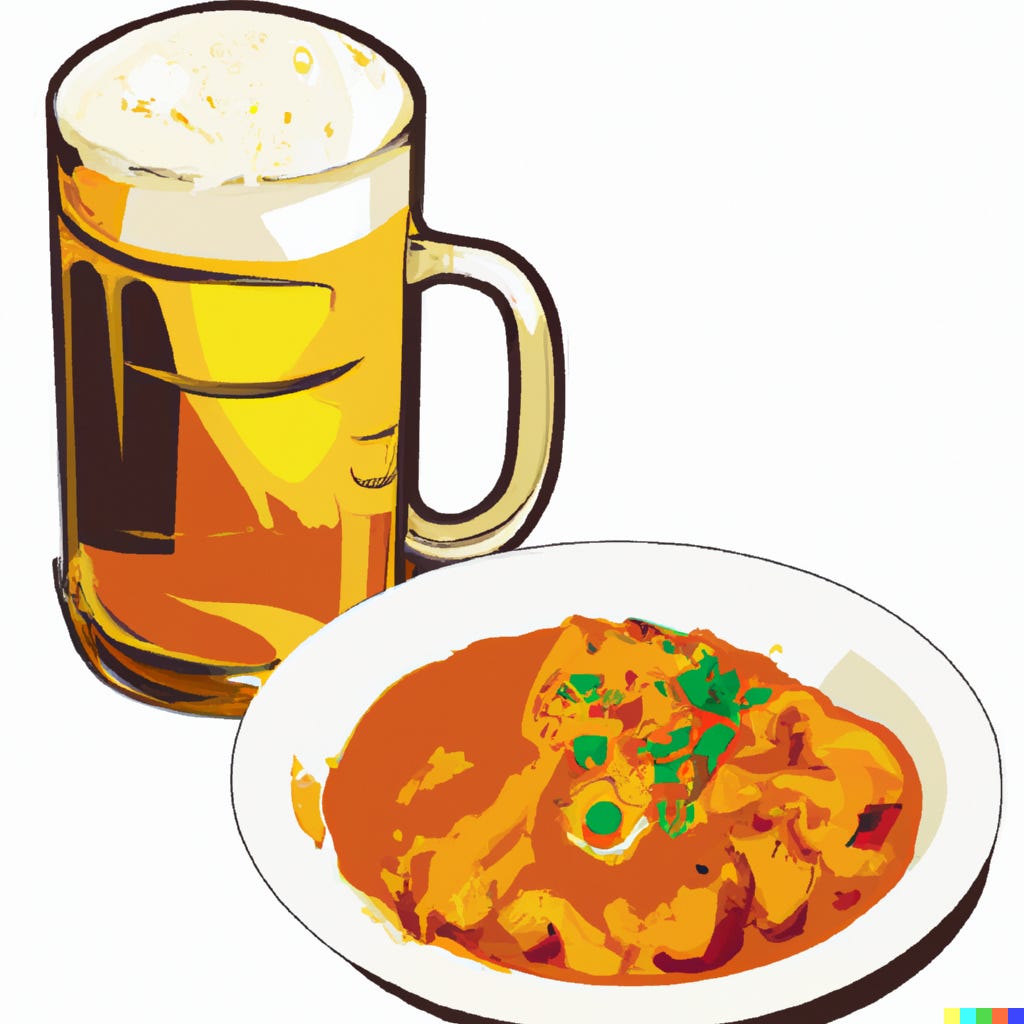
In the most general sense of the term the desi pub is a traditional British public house run by people of south Asian heritage.2 More specifically, they nearly always serve food – good food, at that – typically from the Punjabi repertoire and at prices affordable to most ordinary people. Crucially, unlike in a traditional curry house setting, diners are not prioritised over drinkers and you can just as easily pop in for a quiet pint as you can settle down to an Indian feast. Bristol’s Fishponds Tap is a fine example of a desi pub in which the two groups happily co-exist: visit on a Saturday afternoon in spring and you’ll see families tucking into Nepali momo at the tables whilst Guinness-swilling rugby enthusiasts watch the Six Nations on the big screen from their vantage at the bar.
In this sense the desi pub represents a quite unique cultural fusion. It is a reimagining of the traditional drinking establishment of the British urban working classes – with all its concomitant hallmarks, mores and vernaculars – by (and initially for) members of the Indian-subcontinental diaspora. But the melding of the traditions of pub culture with the values and enthusiasms of desi landlords and punters has created something that is more than simply an Indian interpretation of a pub, or a pub for south Asian immigrants. Of course, they have provided much-needed safe spaces for non-white drinkers and essential hubs for their communities, but desi pubs are somehow better pubs for the very fact that they are desi. This is not to say that desi pubs are in any way superior to traditional pubs, but rather that the very concept of the pub per se is enriched by the evolution of the desi type. For it is thanks to the desi pub that the notion of “the pub” can now have real meaning – as a place to argue, to celebrate, to be distracted and to be comforted; in short as a place to belong – to a much wider range of people.
Whilst researching his recent, excellent guide to the UK’s desi pubs, David Jesudason was struck by the extent to which white working-class urban communities have come to love the Indian-run boozers that have become established in diverse areas. “Instead of running away or complaining about ‘immigration’”, he writes, “these ordinary people embraced change and discovered their lives could be enriched by it”. This represents quite the transformation from the hostile environments to which the desi pub traces its origins. Over a period of a generation or more, through their energy, dedication and mutual support, desi landlords3 and the communities they serve have set light to beacons of multiculturalism in cities the length and breadth of the country.
One of the very newest desi pubs is in Hampton in Arden, a rural, affluent – and predominantly white – village a few miles outside of the suburban overspill of Birmingham, which is considered by many to be the desi pub capital of the UK. This is a post-office-primary-school-and-a-church sort of a place: redbrick cottages with well-tended gardens, shiny saloons on gravelled driveways and neighbourly chats in the village shop. It has a stout Victorian railway station and a cricket club with a prefabricated clubhouse. It has been represented by a Conservative MP since most of its residents can remember.
Hampton’s Soho Tavern is the latest outpost of a chain of desi pubs run by Mikey Singh. (The original Soho Tavern is in Birmingham’s Handsworth and there are also branches in West Bromwich, Newcastle and Gateshead.) It occupies a substantial Georgian townhouse-style building not far from the centre of the village and, at risk of slipping into real estate agent-speak, its elevated dining room affords impressive views across a large lawned garden to the rear and bucolic farmland beyond. In location, it’s about as far removed from the urban origins of the desi pub as you can get.
The menu, however, is a familiar roll call of British-Punjabi classics, executed with panache. There are rich, deeply spiced curries that stain your fingers yellow and pillowy, blistered naan breads for scooping them with. There is tandoori chicken, perma-tanned a Trumpian orange by its marinade, dals that invigorate and soothe with the same mouthful and, of course, the theatrical sizzle of the mixed grill, positively singing from its cast iron hotplate. Vegetarians and vegans are well served by a separate menu offering both meat-free and entirely plant-based dishes. The veg butter “chicken” substitutes soya for poultry and the “fish” pakora comprises golden-battered, deep-fried strips of the same.
The clientele comprises both local villagers excited at the new addition to their neighbourhood’s casual drinking and dining options and a great many South Asian families from the nearby city, some perhaps patrons of the original Soho Tavern here to support the management’s new venture. The place appears to be thriving and one hopes it continues to do so. Rural areas are among the least diverse in the UK and research has shown that people of colour in the British countryside – both residents and visitors – often face considerable prejudice because of their race. It would be naïve to suggest that a few Indian-run village boozers can remedy such deeply embedded structural inequalities but it should be said that the very existence of rural desi pubs4 signals significant progress. In the latter quarter of the 20th Century, desi pubs served as bulwarks for racial harmony in urban areas; perhaps in some small way they can have a positive social impact on rural locales in the 21st.
Whether in sleepy village or bustling inner city, desi pubs more generally can be seen as precious – and singularly British – examples of successful multiculturalism. Through their evolution over a period of multiple decades, what was once a place of division – the pub – has been transformed into a site of social cohesion. In the post-Brexit era, it is tempting to hold up the desi pub as a vital symbol of unity. More prosaically, though, they are precisely what their landlords and patrons intend and need for them to be: more often than not they are quite simply good pubs.
Malcolm X himself was refused service in the Blue Gates pub during his aforementioned visit to Smethwick. In a delicious turn of irony, the Blue Gates, popular with West Bromwich Albion supporters on matchdays, is now a desi pub, run by Jat and Narinder Singh.
The word “desi” comes from Sanskrit and is used to refer to something – people, cultures, products – “from the country”. The country in this context is the Indian subcontinent generally and so desi pubs might be managed by people with heritage from Pakistan, Bangladesh, Sri Lanka and Nepal as well as India itself.
By and large, the gendered nature of the term “landlord” is accurate. According to Jesudason, currently the only desi “landlady” is Megha Khanna of the Gladstone in Borough, south London.
The Ivy Inn in North Littleton in Worcestershire is another example of a rural desi pub.